
Secondary to Primary Cosmic Rays
Primary-to-Secondary ratios
Let us perform a simply estimate of the Boron-to-Carbon ratio. Boron is chiefly produced by Carbon and Oxygen with approximately conserved kinetic energy per nucleon (see Superposition principle), so we can relate the Boron source production rate, to the differential density of Carbon by this equation:
where, denotes the average interstellar gas number density and
is the Carbon density and
is the Carbon velocity and
is the spallation cross-section of Carbon into Boron.
The Boron density is related to the production rate by the lifetime of Boron in the Galaxy, , before it escapes or losses itself energy by spallation:
where we used assuming a constant per unit time lifetime (see next Leaky Box model). So we can write:
Boron-to-Carbon ratio
The plot below represents the 2014 measurements from PAMELA and AMS satellites of the Boron-to-Carbon ratio. The decrease in energy of the Boron-to-Carbon ratio suggests that high energy CR spend less time than the low energy ones in the Galaxy before escaping.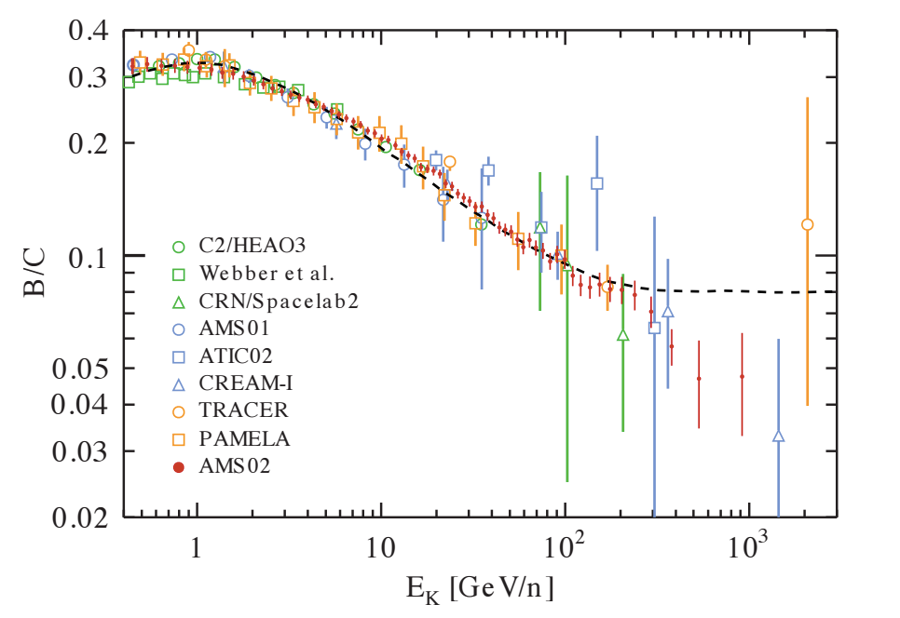
Above about 10 GeV/nucleon the experimental data can be fitted to a test function, therefore the Boron-to-Carbon ratio can be expressed as:
For energies above 10 GeV/nucleon we can approximate , which leads, using the values of the cross-section, to a life time gas density of:
But what is this Boron lifetime? The lifetime for Boron includes the catastrophic loss time due to the partial fragmentation of Boron,
and the escape probability from the Galactic confinement volume,
. The fragmentation cross section is
mbarn so we find that:In [4]:
Latex("The boron lifetime is approx: %.2e s cm$^{-3}$" %(1/0.250/1e-24/2.998e+10))Out[4]:The boron lifetime is approx: 1.33e+14 s cm
which is a good match with the loss time bound at 1 GeV but is larger at higher energies and does not depend on energy. For example at 1 TeV it is an order of magnitude larger:
It could be that Borom escape the leaky box, but that time will be which will be roughly:
which is too small compared to the effective lifetime found. This seems to indicate that CR do not travel in straight lines. Let's assume that the overall process is a convination of both the borom fragmentation and another process with a lifetime . By summing the inverse of these processes (being exponential processes):
and solving for we have that:
There no other physical loss process for Boron, so really must be the escape of the galactic confinement (leaky box). But if the box has a size
,
will be H/c which is the time required by CR generated in the Galactic plane to escape the box of height
! However we know that
. So there must be something else confining the CR in the galaxy... what could it be?
Last updated