
Diffusion of Cosmic Rays
Primary-to-Secondary ratios
Let us perform a simply estimate of the Boron-to-Carbon ratio. Boron is chiefly produced by Carbon and Oxygen with approximately conserved kinetic energy per nucleon (see Superposition principle), so we can relate the Boron source production rate, to the differential density of Carbon by this equation:
where, denotes the average interstellar gas number density and
is the Carbon density and
is the Carbon velocity and
is the spallation cross-section of Carbon into Boron.
The Boron density is related to the production rate by the lifetime of Boron in the Galaxy, , before it escapes or losses itself energy by spallation:
where we used assuming a constant per unit time lifetime (see next Leaky Box model). So we can write:
Boron-to-Carbon ratio
The plot below represents the 2014 measurements from PAMELA and AMS satellites of the Boron-to-Carbon ratio. The decrease in energy of the Boron-to-Carbon ratio suggests that high energy CR spend less time than the low energy ones in the Galaxy before escaping.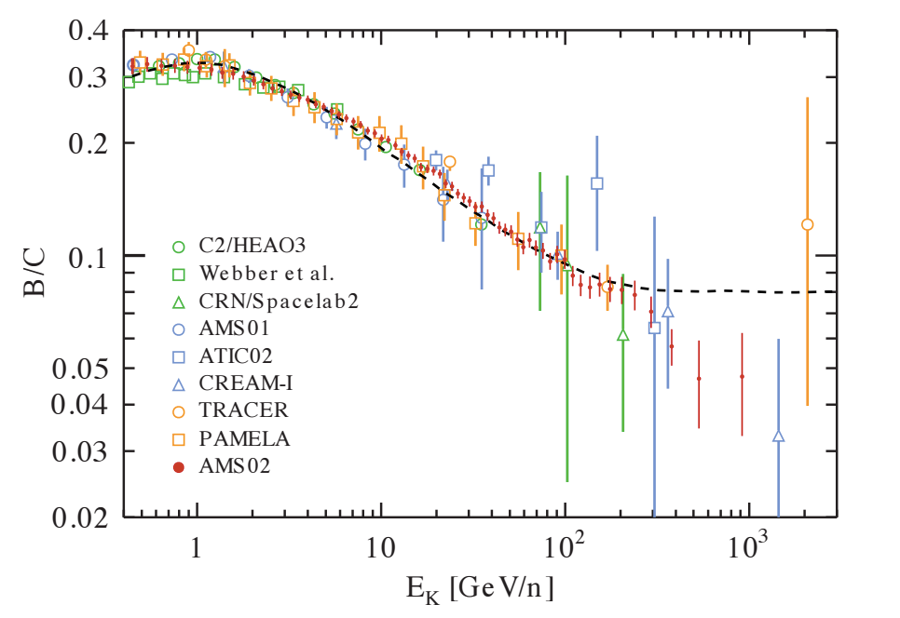
Above about 10 GeV/nucleon the experimental data can be fitted to a test function, therefore the Boron-to-Carbon ratio can be expressed as:
For energies above 10 GeV/nucleon we can approximate , which leads, using the values of the cross-section, to a life time gas density of:
But what is this Boron lifetime? The lifetime for Boron includes the catastrophic loss time due to the partial fragmentation of Boron,
and the escape probability from the Galactic confinement volume,
. The fragmentation cross section is
mbarn so we find that:In [4]:
Latex("The boron lifetime is approx: %.2e s cm$^{-3}$" %(1/0.250/1e-24/2.998e+10))Out[4]:The boron lifetime is approx: 1.33e+14 s cm
which is a good match with the loss time bound at 1 GeV but is larger at higher energies and does not depend on energy. For example at 1 TeV it is an order of magnitude larger:
It could be that Borom escape the leaky box, but that time will be which will be roughly:
which is too small compared to the effective lifetime found. This seems to indicate that CR do not travel in straight lines. Let's assume that the overall process is a convination of both the borom fragmentation and another process with a lifetime . By summing the inverse of these processes (being exponential processes):
and solving for we have that:
There no other physical loss process for Boron, so really must be the escape of the galactic confinement (leaky box). But if the box has a size
,
will be H/c which is the time required by CR generated in the Galactic plane to escape the box of height
! However we know that
. So there must be something else confining the CR in the galaxy... what could it be?
Dynamic of charge particles in magnetic fields.
Let's assume the simplest case of a test particle or mass and charge
and lorentz factor
in an uniform static magnetic field,
.
knowing the expression of we derive this:
In a magnetic field the acceleration is always perpendicular to so
resulting in:
This equation tell us that there is no change in the the parallel component of the velocity and the aceleration is only perpendicular to the magnetic field direction,
. Beacuse
is constant this results in a spiral motion around the magnetic field. Now we are going to test what happens if the magnetic field is not uniform.
Scattering in a Plasma
The picture above holds while the gyroradius is larger or smaller than the variation of the magnetic field. In the first case when the charge particle will follow the substructure of the magnetic field. In the second case
the magnetic field irregularities are transparent to the particle. However when
then the particle sees the magnetic irregularities. In this case the particle will scattered almost inelastically in this irregularities. The picture of a test-particle moving in a magnetic field is a simplistic one. In reallity cosmic ray particles propagate in collisionles, high-conductive, magnetized plasma consisting mainly of protons and electrons and very often the energy density of cosmic ray partciles is comparable to that of the background medium and as a consequence, the electromagnetic field in the system is severely influenced by the cosmic ray particles and the description is more complex than the motion of a test charged particle in a fixed electromagnetic field. This will generate irregularities in the magnetic field. The irregularities in the Galactic magnetic field are responsible for the diffusive propagation of cosmic rays.
Diffusion
In diffusion the continuity equation states that the variation of the density in time is given by its transfer of flux in area plus the source contribution:
where is intensity of any local source of this quantity and
is the flux.
Fick's first law: the diffusion flux is proportional to the negative of the concentration gradient in an isotropic medium:
where the proporcionality constant, , is called diffusion coefficient. Which leads to the diffusion equation of:
where is the Laplace operator.
In the Leaky Box model the diffusion equation, ignoring other effects, can be written as:
Where is the diffusion coefficient and
is the Laplace operator. We made use of the fact that the escape probability is constant per unit time (Poisson process) and so the distribution in time can be writen as:
In the absent of collisions and other energy changing processes, the distribution of cosmic ray path lengths can also be written as:
with the travel distance in the z-axis and
the heigth of the box. Using both expressions of the cosmic ray distribution (in time and in space), together with the diffusion formula above give us equation:
However we found from the B/C ratio that with
, therefore the diffusion coefficient is:
Note that physically ie, diffussion will depend on distance to the disc, however in the leaky-box model we assumed that
is independent of that, which it is only an approximation.
The state-of-art of Diffusion
Transport equation on Primaries
The general simplified transport/dissusion equation that relate the abundances of CR elements can be given by:
where now is the local production rate by a CR accelerator, the middle part reprensents the losses due to interactions with cross-section
and decays for unestable nuclei with lifetime
. The last term is the feed-down production due to spallation processes of heavier CR. We can simplified this equation depending if we are dealing with Primary or Secondary CR:
Primaries
neglect spallation feed-down.
Secondaries
For example, let's assume now a primary CR, , where feed-down spallation is not taking place (ie, they are not product of heavier CR) and no decay (most nuclei are stable, one exception is
Be which is unstable and
-decay), the equation can be written as:
where we wrote and
is the mean free path in g / cm
.
While is the same for all nuclei with same rigidity,
is different and depends on the mass of the nucleus. The equation suggests that at low energies the spectra for different nuclei will be different (eg for Fe interaction dominates over escape) and will be parallel at high energy if accelerated on the same source. For proton with interaction lengths
at all energies so the transport equation gets simplified to:
ie, we observe at Earth a proton density of , and
goes with the inverse of the diffusion coefficient
, ie
, then at the production site the spectrum must follow
with:
Last updated